
Why more and more SMEs in Málaga are adopting artificial intelligence
Nobody needs to tell you: you are seeing it in your own sector. The shop next door replies faster, your competitor no longer misses calls, and you are still doing by hand things others have stopped doing. In Málaga more and more SMEs use AI, and not as a fad: because it saves them time and stops them losing clients. Let's look at what they are actually doing and where they start.
What is pushing this change?
Two things. First, the tools have become accessible and cheap: what needed a custom project three years ago is now built in weeks. Second, the bottleneck for many SMEs is no longer winning clients, it is attending them and coordinating the work without overloading the team. AI fits right there: it answers the repetitive part, moves information between tools and leaves people what truly needs judgement.
The data behind the change
- 41% of Spanish SMEs already use AI daily, according to 2025-2026 sector studies.
- 35% plan to invest in AI in 2026, up from 22% in 2025.
- 61% of SMEs with 10 to 49 employees still run some critical process on paper or Excel (Red.es / Acelera Pyme data).
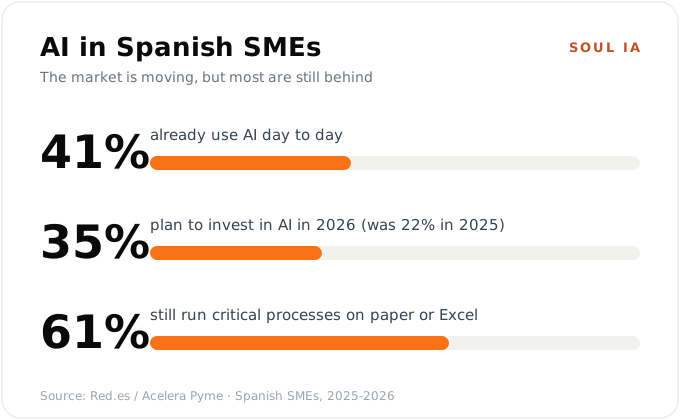
The reading is clear: there is demand and budget, but most businesses still run unordered processes. The brake is no longer the technology, it is deciding what to automate first and doing it with method.
Where do SMEs apply it?
- Customer service and bookings, with chatbots on web and WhatsApp and voice agents that answer the phone.
- Automation of repetitive tasks: client follow-up, internal coordination, moving data between CRM, email and calendar.
- Content and image with generative AI to sell better (from product sheets to real estate renders).
- Training the team to use AI in their own work.
- Data: reports that used to be manual and now arrive on their own every week.
Where they usually start
- Where visible money is lost: unanswered calls and messages (chatbot or voice agent).
- Internal repetitive work: reminders, follow-ups and data copied by hand between tools.
- Team training, so AI is used well and does not become just another tool.
- Data: once the above works, reports come out on their own and decisions improve.
The most common mistakes
- Buying a standalone tool without first ordering the process it should solve.
- Automating a chaotic process: automation multiplies what exists, including the mess.
- Not training the team, so the tool dies in a drawer within a month.
- Measuring nothing, so nobody knows if it worked.
What really changes?
It is not about replacing people, but about taking the repetitive load off them so they spend time on what adds value. SMEs that do it gain margin, respond before their competitors and stop depending on the owner being on top of everything. It usually starts with one well-chosen process, not a giant transformation.
How to start without getting it wrong
Our advice is always the same: diagnosis first. Look at how the team works today, find where time or clients are lost, and automate what hurts most first. Once that works, expand in phases.
Written by
Jorge Marín Pérez · Founder of Soul IA
I help SMEs automate their customer service and processes with AI, from Málaga. What I write here comes from what we build every week for real businesses.
Want to know what you could automate in your business?
Talk to Soul IA