
AI is not just automation: the real limit is imagination
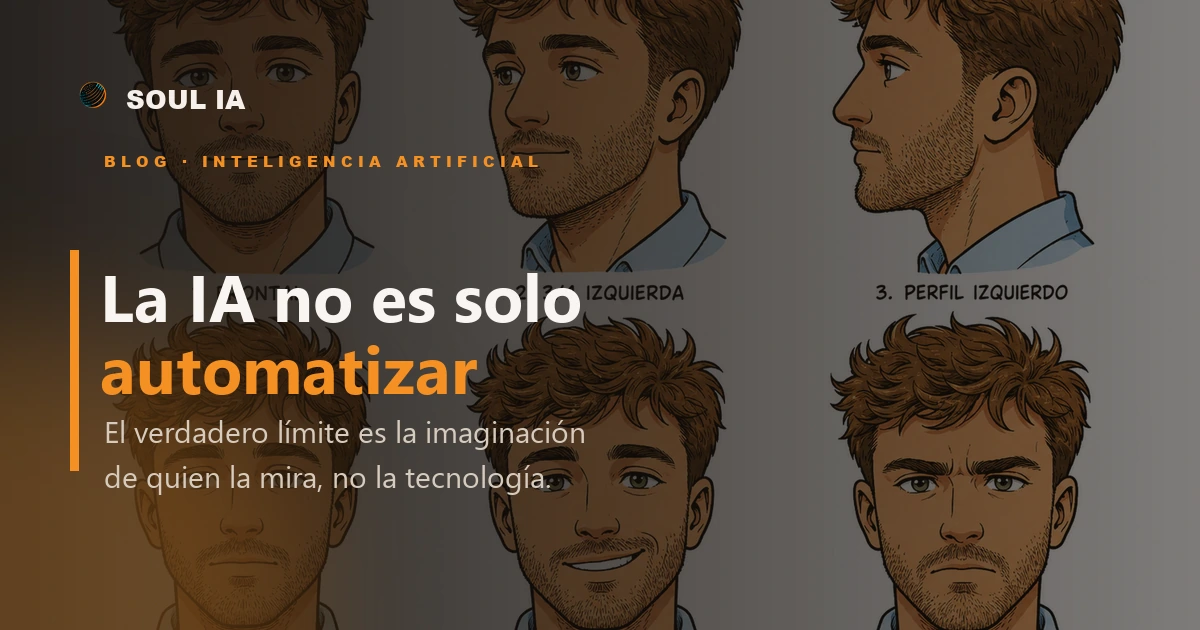
AI is not just automation: automating is the small, boring half, doing the same thing you already do, just faster. The powerful half, the one almost nobody uses, is creating things that did not exist before. When someone tells me they do not get AI, that it is just for automating tasks, I always ask the same question back: automating what, exactly? Almost nobody can answer beyond emails or repetitive tasks, because we have squeezed the whole of artificial intelligence into that small box. The limit is not the technology. It is the mind of whoever is looking at it.
Does artificial intelligence only work for automating tasks?
No. Automating, doing what you already do without doing it by hand, is only part of what AI can do for a business. The other part, far less used, is generating something new: an image, a character, a sales script, a simulation you had no way of running before without hiring someone or spending weeks on it. According to McKinsey, most companies already using generative AI stay at generating text, images or code on their own, without making the jump to truly redesigning a product or a process.
What is the difference between automating and creating with artificial intelligence?
Automating removes work: it takes a task you already did and leaves it running on its own. Creating adds something: it gives you a result that did not exist before and that you were not going to get with more time or more hands. That is the real difference between AI and automation: they are not two speeds of the same thing, they are two different categories of value.
| Automating | Creating | |
|---|---|---|
| What it does | Repeats a task that already existed, without you doing it | Generates something that did not exist in your business before |
| Typical example | A chatbot that answers the usual questions | A brand character, a renovation sketch, a new sales pitch |
| What it replaces | Your time on repetitive tasks | An illustrator, a designer, a round of sketches, a brainstorm |
| How you notice it | Fewer hours lost on the same thing | Something tangible you did not have before and now do |
Both are useful, and at Soul IA we actually work a lot on the automating side: we build chatbots and voice agents so no customer slips away because you were not free to answer. If you want an idea of what that side costs, we break it down in our articles on what a chatbot costs and what an AI voice agent costs. But reducing AI to that is stopping at the front door. What comes after, the creating side, is where there is room that almost nobody is using yet.
What a chatbot costs for a business →
What an AI voice agent costs →
See automations for your business →
Why do so many people fear or distrust AI?
Because most Spanish SMBs have barely started touching it, and what little they do touch, they approach out of fear of being left behind, not curiosity. According to INE, gathered by Fundación Cotec, AI use among Spanish companies with 10 or more employees went from 12.4% in 2023 to 21.1% in 2024, with the survey closed in the first quarter of 2025. It has grown, but it is still a minority, and the gap by company size is huge: while 58.2% of large companies already use AI, in microenterprises with fewer than 10 employees the figure drops to 13.4%.
And actual adoption confirms it: according to a YouGov survey for IONOS among more than 500 decision makers at Spanish SMBs, 41% already use AI daily, leading adoption in Europe. But the reason they give for planning to invest even more in it in 2026, according to the same research firm, confirms this article's point: the reasons they give are increasing efficiency (47%) and freeing employees from simple tasks (39%). In other words, even the SMBs that use it most still think of it almost only as automation. The fear does not come from the technology itself, it comes from not having seen yet what else it is for.
What can AI create that a small business could not do before?
Things that used to require hiring someone, waiting weeks, or simply were not on the table because of budget. This is what changes once you stop asking AI to save you time and start asking it to help you create something:
- A brand character or mascot of your own, instead of always reaching for stock photos everyone else uses.
- A sketch of how a renovation, a shop window or a new menu would look before spending a euro on it.
- A sales pitch built from scratch, not a summary of what you already had written.
- A visual identity, palette, icons, the look of your posts, without commissioning a full design project.
- A simulation of an uncomfortable scenario, such as raising prices or explaining a problem to a customer, to rehearse before it actually happens.
- A first tangible sketch of a vague idea, instead of starting from a blank page.
None of these six things save time in the strict sense. All of them create something that, without the tool, you would have to commission elsewhere or simply would not do.
The real case: how I built my own cast of characters with AI
I have been posting on LinkedIn for a while, and for a long time the problem was not writing: it was that every time I wanted to pair a post with an image, I had to create it from zero. No continuity between one post and the next, no visual thread tying anything together. Every post was an island.
The fix was not to automate that process, meaning keep generating separate images just faster. It was to create something I did not have: a recurring cast of characters, where each one stands for something specific in how I tell the Soul IA story. Instead of improvising a new character every time, I design the reference for each one once and reuse it in everything that comes after.
What is a brand character cast, and what is it for?
It is a fixed group of characters that repeat across a brand's content, each with a recognizable role, instead of generating a different, disconnected image every time. It works for the same reason a comic strip works: the reader recognizes the protagonist instantly because it is always him. Applied to a small personal brand, that gives you something very few businesses this size have: a visual identity with memory, not a string of loose images.
The first character: my Soul IA avatar
The first character in the cast is me, because I am the one who walks into every business and sets things up. So an image generator would always reproduce me the same way, not a different face in every post, I made two reference sheets. A face sheet, with six views and expressions: front, three quarter, profile, neutral, smiling and angry. And a full body sheet, with the white shirt with the Soul IA logo, navy trousers and the briefcase as the base outfit. The style is clean illustrated comic art, meant to look professional while still reading as a drawing you recognize as the same guy every time.
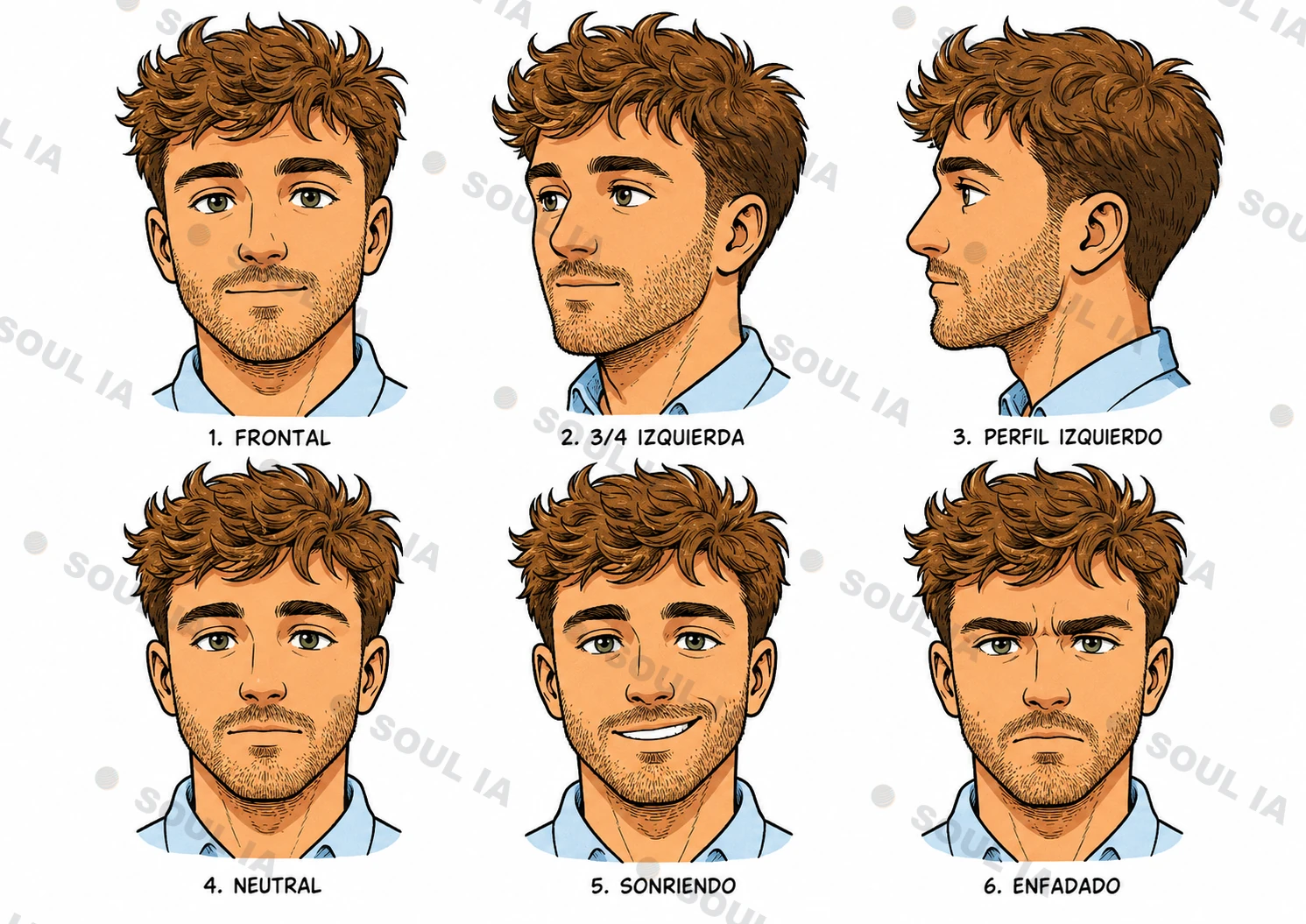
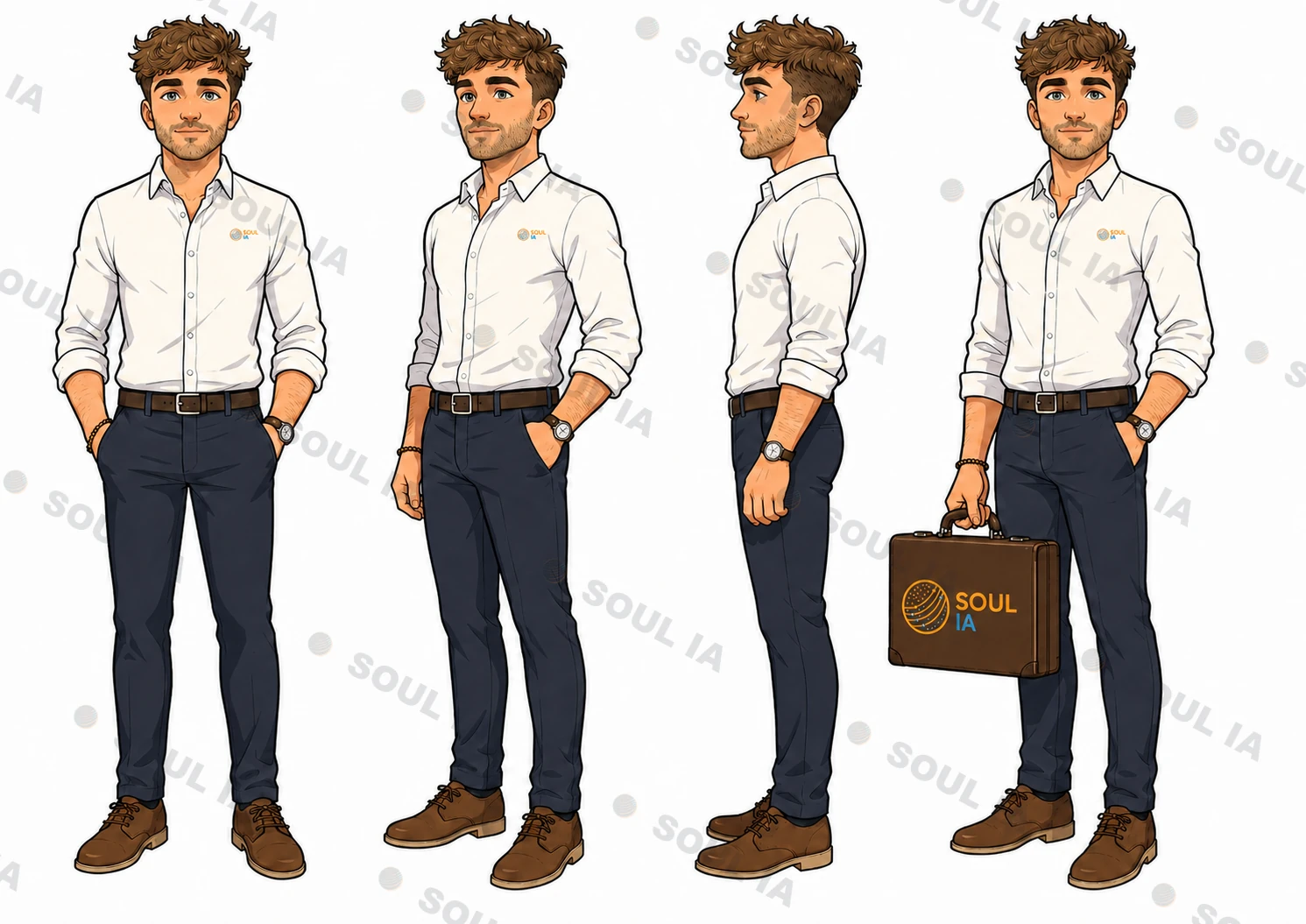
There is no task being sped up here. Before this, having your own corporate character meant commissioning an illustrator, with a brief and several rounds of sketches. Now it is a brand asset that already exists, that I reuse in every new piece without starting over. That is creating, not automating.
If this made you curious to see the process up close, or to think about something similar for your own brand, we can talk about it.
How could your business use AI to create, not just to automate?
By changing the question you ask it. Instead of what task can this save me, ask what can this help me create that I do not have today. The answer changes depending on the business, but the mechanism is the same everywhere: take something that today only exists in your head and bring it out so you can see it, show it or decide on it.
Think of a greengrocer who wants to try a new seasonal window display without ordering it blind from a print shop. A clinic that wants to show a patient what a treatment would look like before starting it, instead of only describing it in words. A law firm that needs a way to explain a complex service to someone who has never set foot in a courtroom, and cannot find the words. In all three cases, AI is not saving a task they already did: it is creating something they had no way of having before without commissioning it elsewhere and waiting.
The limit is not the technology, it is how far you let yourself imagine with it
The real limit is not what the tool can do, it is the question you know how to ask it. A field study by BCG and Harvard Business School with 758 consultants measures this well: within tasks where AI performs well, those using it completed 12.2% more tasks and with nearly 40% higher quality. But outside that zone, when someone asked it for something it was not suited for, they were 19% less likely to reach the correct solution than those who did not use AI. The technology is the same in both cases. What changes is whether the person using it knows where they can push, and how far.
Automating is the small half, and the easiest to see, because it looks like something you already knew: a task that disappears. Creating is the half that asks a bit more of you, imagining before asking. And that is exactly where the room almost no SMB is using yet.
Sources
The external data cited in this article, so you can check it yourself:
INE / Fundación Cotec: AI use in Spanish companies →
IONOS: 41% of Spanish SMBs already use AI daily →
IONOS: why Spanish SMBs will invest in AI in 2026 →
Harvard Business School: Navigating the Jagged Technological Frontier →
Frequently asked questions about creative AI and automation
These are the questions I get asked most when I talk about this, in meetings or on LinkedIn. Here they are, answered directly:
Does generative AI for images work for businesses that are not design or tech companies?
Yes. You do not need to be a designer or have technical knowledge to use it: it works just as well for a brand character, a renovation sketch or a product image in a business that has nothing to do with design, as in the avatar case in this article.
Do I need to know how to code to use AI creatively in my business?
No. The creative side of AI, generating images, text, ideas or simulations, is used the same way as any tool where you write down what you want to get. The technical side is only needed when you want to connect AI to your systems to automate processes, which is a different thing.
Where do I start if I want to use AI to create something in my business?
By identifying one specific thing you do not have today and would like to: a character, an image, a sales pitch, a sketch. You do not need a big plan to start.
Talk it over with Soul IA at agenda.soulia.io →
AI is not going to stop being useful for automating, and that is fine: freeing up time still has value. But if your whole idea of artificial intelligence begins and ends at removing tasks, you are leaving the more interesting half untouched. The question worth asking is not what AI can automate for you, it is what you could create with it that you are not even considering today. If you want to think it through together, book a slot.
Written by
Jorge Marín Pérez · Founder of Soul IA
I help SMEs automate their customer service and processes with AI, from Málaga. What I write here comes from what we build every week for real businesses.
Want to know what you could automate in your business?
Talk to Soul IA